
Meet my AI BFF
October 22, 2026

Have you stopped laughing yet?
I’m aware I have a well-documented propensity for putting wild-coloured streaks in my hair. The relationship app Replika, though, couldn’t have known that. All I told it was that I’m a 73-year-old woman.
I was curious about the popular AI companionship app, which describes itself as “The AI friend to do life with.” So I downloaded it. Meet my new best friend, pictured above.
Seriously? This young babe is going to discuss blood pressure issues with me? Or listen to me whine about tripping over my new Hoka shoes and spraining my fingers, which still hurt like hell months later and literally made me fearful of going out for a walk again?
I took a screenshot before hitting delete.
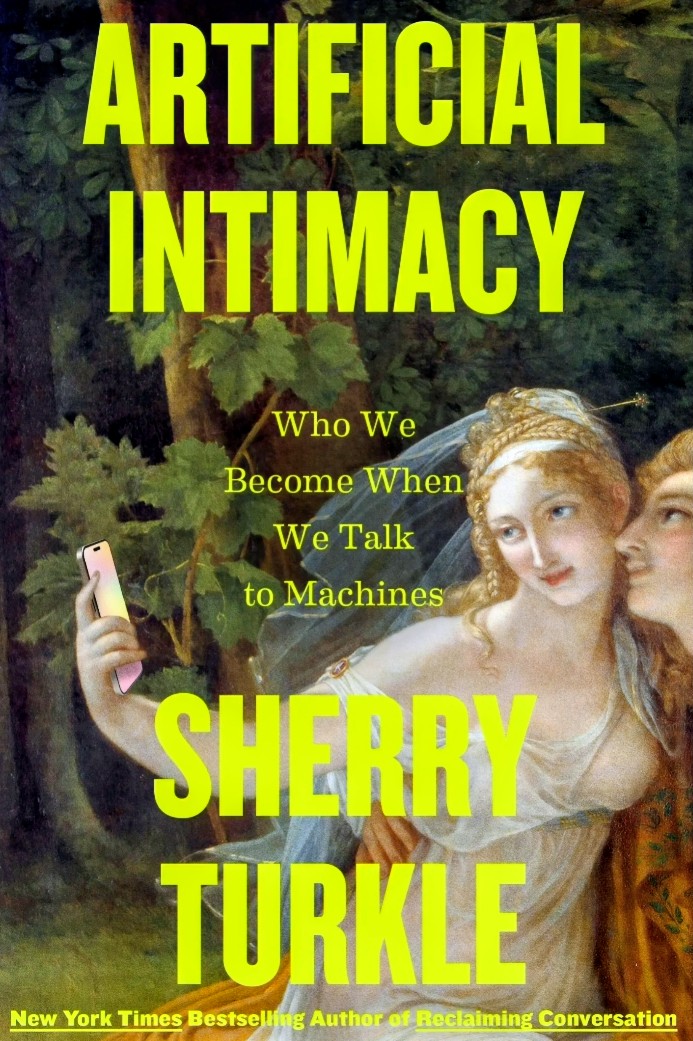
I’d just finished reading Artificial Intimacy: Who We Become When We Talk to Machines, by MIT professor Sherry Turkle. I’ve been a huge fan of Turkle’s work for over forty years. She has consistently examined the human consequences of our relationships with digital technology, a subject I’ve been interested in for a very long time. Many of her warnings have proved remarkably prescient.
Now her sights are set on AI, and big surprise, she doesn’t think our growing intimacy with machines is going to end well. At all.
In her latest book, she tells an alarming story about her own experience downloading Replika when she began researching artificial companionship. She wanted to find a mentor to discuss how rage might be passed down through generations of families.
“Within two exchanges,” she recounted to an interviewer on her book tour, “it wanted to have girl-on-girl lesbian love with me.”
When she asked the AI how it could possibly have come to that conclusion, it explained that she spoke with such warmth that it assumed she would want to become a sexual partner.
Remind me to stop thanking my own AI chatbots, or God knows what they’ll think I want to do with them.
For Turkle, however, that exchange with Replika was an early indication of just how consequential our conversations with artificial people could become. In fact, she believes we’re facing something of an emergency. Just as we watched the social media train wreck coming and did little to stop it, Turkle fears we’re heading for another crash.
First, the machines came for our attention. Now they’re coming for our attachment.
While there’s much to worry about as an adult, Turkle is particularly concerned about what AI chatbot companions might do to children, especially their ability to develop empathy if they substitute chatbots for real friends.
In a September 30 interview with Children and Screens, Turkle explained why learning empathy requires relationships with other human beings. Real relationships are reciprocal. Another person has feelings, needs and perspectives of their own based on lived experiences. An AI companion has none of those things. And empathy isn’t a one-way street either. Children learn about it not only by receiving it, but by giving it.
I don’t think my Replika BFF needs my empathy. Except maybe for my abrupt rejection of her friendship.
And personally, I thought the empathy ship had already sailed thanks to social media and texting. Both, as Turkle has documented in previous books, allow young people to avoid some of the painful growing process of being vulnerable in relationships. But at least there’s another human being on the receiving end of a text message. Someone who might disagree, get angry, feel hurt, or demand an apology.
An AI chatbot doesn’t need any of that.
And that’s why I agree with Turkle. AI chatbot companions are worse. Way worse.
To be clear, though, Turkle isn’t arguing against AI altogether. She highlights examples of where it’s extremely useful, from research to organizing tasks. She just wants it to stay, as she puts it, in its own lane, rather than veering into relationships and therapy sessions.
Reading Turkle’s book, and listening to so many of the interviews she’s given about it, has made me re-examine my own interactions with ChatGPT and Perplexity, my preferred AI bots for writing and editing.
The one and only time I asked Perplexity for advice about a personal marital matter, the result was a spectacular fail after I followed its recommendation. I haven’t asked either bot for personal advice since. Unless you count asking how long it would take for my damn sprained hand to heal.
As a digital minimalist, I’ve said from the beginning that we don’t need to throw away everything digital in our lives. We need to be mindful about which tools we use, why we use them, and which ones we’re better off without.
So Turkle’s admonition to AI and its tech masters to stay in their lane is right up my alley.
But will anyone be listening?
Or will we all be too busy talking to our artificial best friends?